 By Benjamin Lewis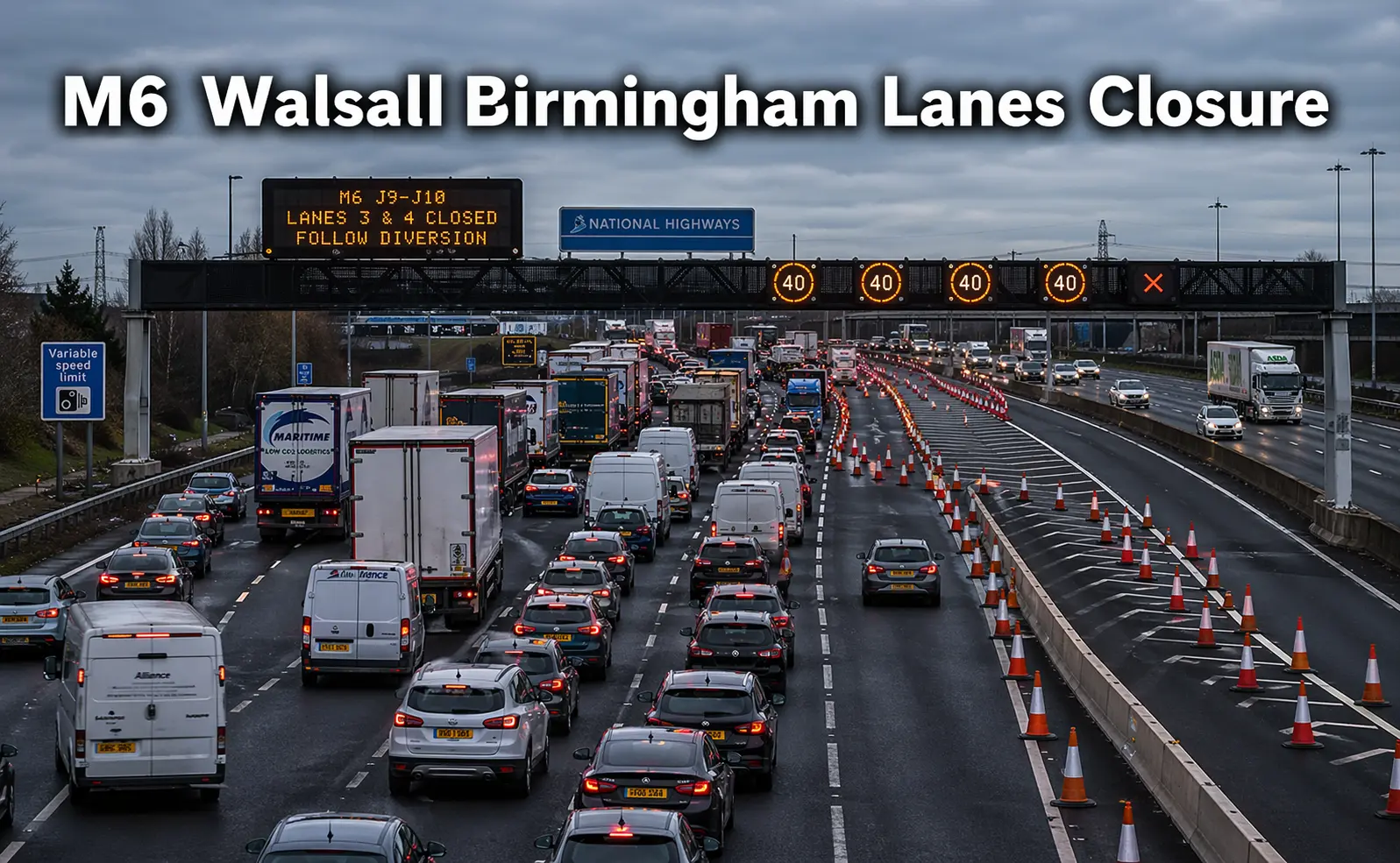
Picture this: you leave home at 7:15am with a meeting locked in at 9:00am. You’ve done this drive dozens of times. The M6 between Walsall and Birmingham is your usual route, predictable enough on a clear day. Then the sat-nav flashes red. A lane closure between Junction 7 and Junction 6 has already backed traffic up two miles. By the time you clear it, you’re 40 minutes behind and still five junctions away.
That’s not a bad-luck story. That’s Tuesday morning on the M6 Walsall Birmingham corridor in 2026. The M6 Walsall Birmingham lanes closure situation has shifted from an occasional inconvenience to a daily reality for tens of thousands of drivers crossing the West Midlands. Understanding what’s actually happening on this stretch, why it keeps happening, and how to manage it intelligently makes a real difference — whether you commute here every day or pass through occasionally.
Why the M6 Between Walsall and Birmingham Is Under This Much Pressure
The M6 through the West Midlands was not designed with 2026 traffic volumes in mind. The section running from Junction 10 near Walsall down through Junction 7 and toward Junction 6 near Birmingham handles a relentless mix of commuter cars, HGVs, delivery vans, and long-distance freight. On any given weekday morning, that combination alone pushes the road toward its practical limit.
When National Highways confirmed emergency barrier repairs between Junction 7 (Walsall) and Junction 6 (Birmingham) in April 2026, they cited two lanes closed in both directions — northbound lanes 3 and 4, southbound lanes 3 and 4 simultaneously. That’s not a minor restriction. With half the motorway capacity removed from a stretch that carries enormous daily volume, delays of around 30 minutes building on approach become almost guaranteed even before any secondary incident occurs.
The structural reality is that the road was built when freight volumes were lower, smart motorway technology didn’t exist, and the West Midlands population and industrial activity were considerably smaller. Walsall Council’s own highways documentation now references active National Highways improvement work specifically affecting Junction 10, alongside Transport for West Midlands (TfWM) bus priority corridor construction linking Walsall to Birmingham city centre. That’s simultaneous pressure from multiple infrastructure projects hitting the same geography.
The Real Scale of Current Roadworks in 2026
The closures are not random or uncoordinated — though they can certainly feel that way from behind the wheel. National Highways has been working through a phased maintenance schedule across the West Midlands section of the M6 that began in early 2026 and extends well into summer.
Bridge maintenance near Junctions 5 and 6 started early in the year. In March 2026, temporary full carriageway closures ran between Junction 10 and Junction 7, operating weeknights between 9pm and 6am. Spring 2026 brought further resurfacing and upgrade work across multiple sections. Right now, confirmed upcoming closures show the M6 northbound between J5 and J7 under a roadworks scheme running from late April through to 13 June 2026, with lane closures on J5 to J6 northbound operating on multiple overnight windows through May.
These are not emergency patches. They’re long-overdue infrastructure investments. Bridge joints that carry Victorian-era construction history cannot simply be swapped for off-the-shelf repairs. National Highways has acknowledged that bespoke design and specialist manufacturing is required for certain structures, and that timeline pressure is real but cannot compromise safety. For the driver sitting in queue, though, the practical effect is the same regardless of how justified the work is.
The overnight window of 9pm to 6am limits daytime disruption in theory. In practice, freight traffic doesn’t stop at night, early commuters hit the residual effects before workers clear the site, and any overrun pushes the closure into morning peak hours. One night of complex work near Junction 7 can echo in traffic data for the entire following morning.
How Accidents and Breakdowns Multiply the Problem
Planned roadworks are at least predictable. What makes the M6 Walsall Birmingham corridor particularly difficult is how quickly unplanned incidents compound any existing restriction.
On 23 April 2026, a road traffic collision was recorded on the M6 southbound between Junction 10 (Walsall) and Junction 9 (Wednesbury) with active lane closures. That incident ran alongside congestion already affecting the southbound stretch between Junction 11 and Junction 10, where delays of 10 minutes were building against expected traffic at 6am. Two separate disruptions, less than two junctions apart, at 6 in the morning.
When an accident closes multiple lanes on a stretch already operating under maintenance restrictions, the mathematics of congestion become brutal. Traffic that would normally distribute across four lanes suddenly competes for one or two. Vehicles brake, merge aggressively, and slow to a crawl. A collision that might clear physically in 45 minutes can leave traffic absorbing its effects for two to three hours afterward, because the queue simply cannot drain at normal speed once it’s built to that length.
Breakdowns are quieter triggers but equally effective at generating gridlock. A single lorry stopped in lane one forces all traffic left. Drivers who weren’t expecting it brake sharply, creating a pressure wave that travels back through the queue. The M6 Walsall Birmingham lanes closure problem isn’t just about planned works — it’s about a road corridor that has no spare capacity to absorb even minor unplanned events without cascading consequences.
Smart Motorway Technology: Helpful, But Not a Fix
Variable speed limits and lane management systems have been installed across sections of this stretch. In theory, they smooth traffic flow, reduce sudden braking, and help drivers anticipate changes earlier. In reality, the West Midlands M6 corridor operates at a volume where these systems manage the symptoms rather than the cause.
Smart motorway controls rely on consistent, predictable driver behaviour to work as designed. This stretch offers neither. Vehicles merge aggressively near Great Barr, drivers switch lanes frequently under pressure, and the mix of HGVs travelling at lower speeds alongside faster commuter traffic creates friction points that technology can monitor but cannot eliminate.
When a smart motorway lane is taken out of service for maintenance or following an incident, drivers sometimes find the restrictions feel more severe than on a conventional motorway because the system controls access more tightly. The flexibility to simply filter around a problem is reduced. For commuters trying to read the route in real time, this creates genuine confusion about what the signs mean and how to respond safely.
Alternative Routes: Honest Assessment
The M6 Toll is the most commonly suggested alternative for drivers wanting to bypass the Walsall-Birmingham section entirely. It works, but it costs, and during major closures it attracts enough diverted traffic to create its own delays. The M5 and M42 can absorb some pressure from drivers rerouting further out, but they are not limitless. When the M6 corridor is severely disrupted, the effect spreads across the regional network measurably.
Local roads through Birmingham and Walsall are simply not built for motorway-level diversion volumes. The A34 Birmingham Road, which sees around 20 percent higher vehicle counts during M6 disruption periods, moves slower and involves traffic lights, pedestrian crossings, and urban junctions that don’t exist on a motorway. A driver who leaves the M6 expecting to save 20 minutes frequently discovers they’ve added 40.
The honest advice: alternative routes provide genuine relief only if you use them before the main queue forms, not once you’re already caught in it. Real-time traffic data from apps like Waze or Google Maps, or the National Highways Traffic England website, can identify the moment a closure is impacting flow and give you a window to reroute before local roads fill up too. Once the queue is established, every driver around you has the same idea.
What Timing Actually Tells You
Not all closures cause the same level of disruption, and timing is the most important variable. A lane closure at 2am on a Wednesday affects freight operators and night workers. The same closure starting at 7am on a Monday can produce tailbacks stretching back beyond Junction 11 within 20 minutes.
Morning rush hours between roughly 7am and 9:30am are the most sensitive window on this corridor. Any restriction during that period amplifies immediately. Evening peak from 4:30pm to 6:30pm is the second most vulnerable time. Midday closures have impact but typically recover faster because background volume drops enough for traffic to breathe.
Weekend closures carry a different character. Daytime Saturday volumes are lower but leisure traffic is less predictable about route choices, and drivers unfamiliar with the area may not know the diversions as well. Full overnight weekend closures with signed diversions send high volumes onto A-roads that aren’t set up for it, and the knock-on effect is often felt on Sunday morning as drivers who avoided the route the night before all return at once.
Planning your journey around confirmed closure schedules — available on the National Highways daily closures page and the Traffic England live site — is the single most effective thing you can do. Checking the morning of travel, not the evening before, gives you the most accurate window.
The Longer Picture: Why This Isn’t Improving Quickly
The M6 Walsall Birmingham corridor is caught between two realities. The infrastructure needs significant investment — and that investment is now actively happening — but the scale of the works required means disruption is unavoidable through the process. Resurfacing, barrier repairs, bridge maintenance, and technology upgrades cannot all be completed behind screens on a closed road overnight. The timeline extends through most of 2026 at minimum, with individual project phases confirmed running as far as 13 June 2026 already, and further windows expected to be announced.
Traffic demand is not decreasing in the West Midlands. Regional growth, logistics expansion, and commuter patterns all sustain or increase vehicle numbers on this corridor. The gap between what the road was designed to carry and what it actually carries isn’t narrowing on its own. Every driver who chooses this route contributes to the baseline pressure that makes even a modest closure disproportionately disruptive.
The improvements, once complete, should deliver measurably smoother flow, better barrier safety, more reliable journey times, and infrastructure capable of handling smart traffic management more effectively. That’s a real long-term benefit. But for drivers navigating the M6 Walsall Birmingham lanes closure situation through spring and summer 2026, the short-term picture is one of continued patience and active journey planning.
Final Thoughts
The M6 Walsall Birmingham lanes closure is not a short-term problem with a short-term solution. This corridor is under sustained pressure from ageing infrastructure, modern traffic volumes, and a significant schedule of necessary roadworks that will continue through 2026. Accidents, breakdowns, and the residual effects of overnight works all layer on top of that baseline, making delays not the exception but the reliable expectation for drivers on this route.
The most practical thing you can do is use real-time information rather than assumptions. The National Highways Traffic England page and live traffic tools update regularly and give you the clearest picture of what’s actually happening before you commit to the route. Leave buffer time in your morning, check closure schedules the day before anything time-critical, and treat the M6 Toll not as a premium but as a genuinely faster option on the worst days. The infrastructure investment happening right now is real, and the road will eventually benefit from it — but getting through the disruption period with minimum stress means planning around the M6 Walsall Birmingham lanes closure rather than being surprised by it.
FAQS
How long do M6 Walsall Birmingham lane closures typically last?
Planned overnight closures run 9pm to 6am on weekdays, though complex works can overrun. Emergency closures following accidents clear in 45 minutes to 3 hours depending on severity, but congestion aftermath persists longer.
Which junctions are most affected by the current closures?
Junctions 5, 6, 7, 9, 10, and 10A are all seeing active or confirmed upcoming disruption in 2026. The J7 to J6 stretch has seen the most significant restrictions, including simultaneous two-direction lane closures for barrier repairs.
Is the M6 Toll a reliable alternative during major closures?
Yes, on most days it bypasses the worst disruption effectively. During widespread incidents it attracts heavier diversion traffic, so it’s faster to join it early rather than after the main queue builds.
Where can I check live M6 closure information before travelling?
The National Highways Traffic England website, the National Highways daily closures page, and Walsall Council’s one.network roadworks map are the most reliable official sources. Real-time apps like Waze and Google Maps also reflect live conditions accurately.
Will disruption on the M6 Walsall Birmingham corridor improve before the end of 2026?
Some phased works will complete through summer, which should reduce individual closure windows. However, new phases are regularly confirmed, and overall disruption is expected to continue as a feature of this route throughout the year.