 By Benjamin Lewis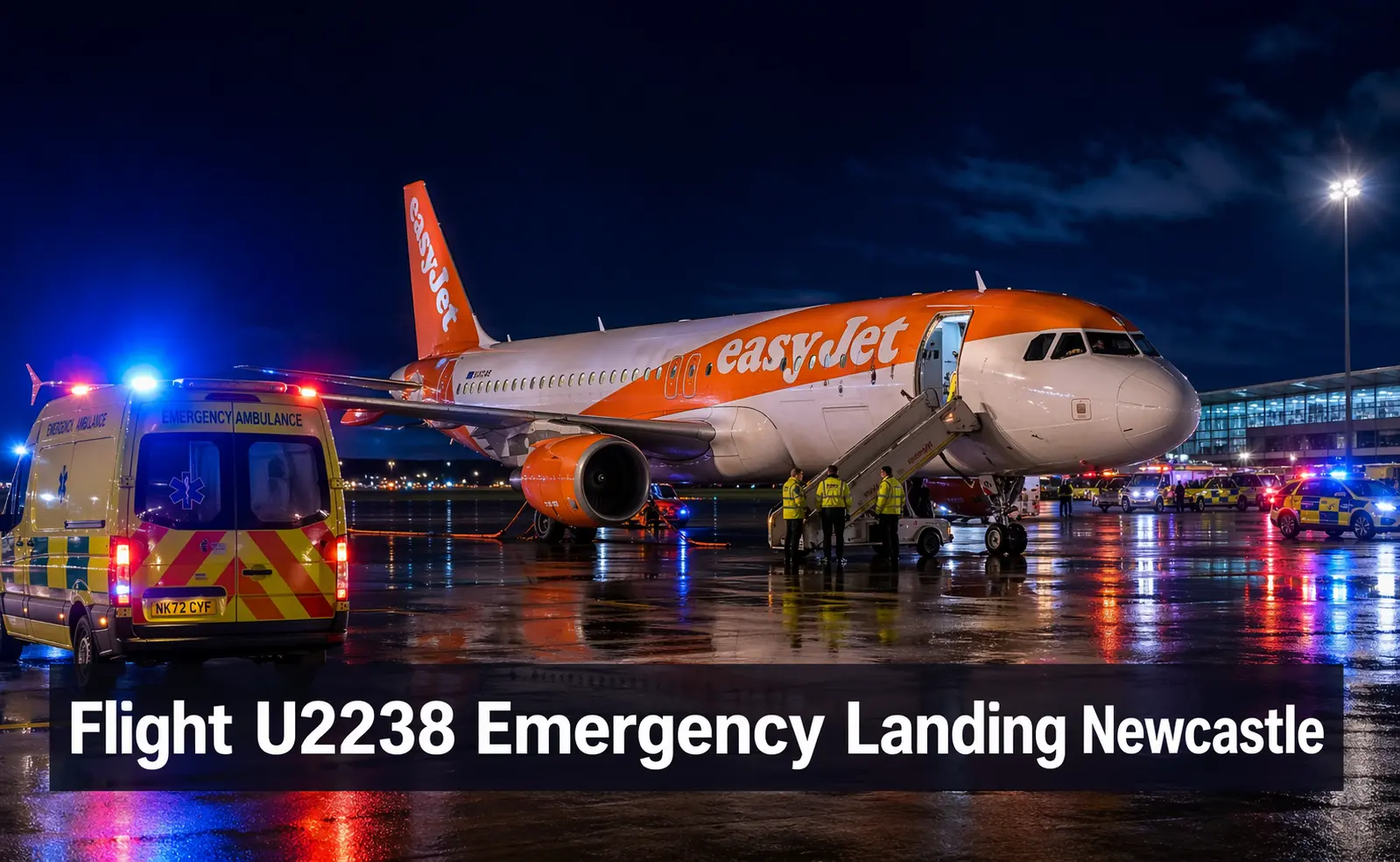
Picture yourself settling into your seat on a late-evening flight from Copenhagen to Manchester. The cabin lights are low, some passengers are dozing off, and you’re expecting to land in roughly two hours. Then, without warning, the atmosphere shifts entirely. That’s exactly what happened on the night of 27 October 2025, when EasyJet Flight U2238 emergency landing Newcastle became one of the most talked-about aviation incidents across the UK. What started as a completely ordinary European route turned into a life-or-death response that tested every layer of modern aviation’s safety system — and proved those systems work.
What Was EasyJet Flight U2238 and Where Was It Headed?
EasyJet Flight U2238, flight code EZY2238, was a scheduled commercial service operating on the Copenhagen to Manchester route aboard an Airbus A320. It’s a well-travelled European corridor that EasyJet operates regularly without incident. The aircraft departed Copenhagen Airport at approximately 10:13 PM CET and was expected to arrive at Manchester Airport within a standard two-hour window.
Nothing unusual was flagged before takeoff. The aircraft was technically cleared, the crew was fully rostered, and passengers had settled in for what should have been a routine evening journey. Within minutes of being airborne, however, that routine was about to be broken completely.
How the Medical Emergency Unfolded Mid-Air
Less than 15 minutes after departure, a passenger onboard began showing signs of serious medical distress. Cabin crew were alerted and moved quickly to assess the situation. What started as visible discomfort escalated within minutes into symptoms severe enough — breathing difficulties, significant physical weakness — that it was clear this wasn’t something that could wait until Manchester.
Cabin crew administered first aid from the onboard medical kit, provided oxygen support, and continuously monitored the passenger’s condition. They also checked with other passengers to see whether any qualified medical professional was onboard who could assist. All of this happened while the aircraft was at cruising altitude, somewhere over the North Sea, with no hospital anywhere nearby. The pressure in those moments is something most people never consider when they board a flight.
Once it became clear to the cabin crew that the situation was serious enough to escalate, they informed the flight deck. The pilots now faced a decision that could not wait.
The Decision to Divert: Why Newcastle Was Chosen
The captain’s decision to divert to Newcastle Airport was not random — it was calculated under real-time pressure. Pilots are trained to run through a specific decision matrix when a diversion becomes necessary, and multiple factors converged on Newcastle as the correct answer that night.
Geographically, Newcastle was the nearest suitable airport capable of safely receiving an Airbus A320 at that time of night. Continuing to Manchester would have added roughly 25 to 30 additional minutes in the air — and in a genuine medical emergency, that margin of time can be the difference between life and death. Newcastle Airport also had immediate access to North East Ambulance Service responders and is positioned within close range of the Royal Victoria Infirmary, one of the leading hospitals in the North East of England.
Think of it this way: if someone collapses at home, you don’t drive to a hospital that’s 45 minutes away when there’s one 15 minutes down the road. The same logic applies here, scaled to 30,000 feet.
Once the diversion decision was locked in, the pilots activated the appropriate emergency signal — Squawk 7700, the international transponder code for a general aviation emergency — alerting air traffic control that this aircraft needed priority handling immediately.
How Air Traffic Control and Ground Teams Responded
The coordination that happened over the next several minutes is a remarkable display of the invisible infrastructure that keeps air travel safe. Air traffic control at Newcastle received the squawk and immediately began clearing the relevant airspace, prioritising Flight U2238’s descent path over all other traffic in the region. Controllers communicated approach vectors and landing clearance in real time, all while coordinating simultaneously with airport ground operations.
On the ground at Newcastle Airport, the response was already in motion before the aircraft touched down. Fire crews positioned themselves near the runway as standard emergency protocol. Medical responders from the North East Ambulance Service were staged at the gate. Airport operations staff coordinated the arrival stand so the aircraft could stop and be accessed as quickly as possible.
The aircraft landed safely at Newcastle Airport at approximately 10:52 PM GMT — roughly 39 minutes after departure from Copenhagen. That timeline tells its own story. From the moment the emergency was declared to wheels-down, the entire chain of communication, decision-making, and logistical preparation was executed in under 40 minutes.
What Happened After Landing
As soon as the aircraft came to a complete stop, paramedics boarded immediately and assessed the passenger. The affected individual was transferred off the aircraft and transported to medical facilities for further treatment. EasyJet confirmed the diversion publicly with a clear, concise statement: Flight EZY2238 from Copenhagen to Manchester on 27 October diverted to Newcastle due to a customer onboard requiring urgent medical attention.
No other passengers or crew members were reported to have been harmed during the incident. The remaining passengers were eventually assisted with onward travel arrangements, and the aircraft underwent a standard post-diversion check before returning to service.
For the passengers onboard, the experience was undeniably unsettling in the moment. Several accounts later noted that what calmed them down wasn’t just the safe landing — it was the demeanour of the crew throughout. Regular, honest updates from the cabin team kept the atmosphere from spiralling into panic. That’s not a small detail. Passenger behaviour during an emergency can either support or complicate the crew’s ability to manage the situation, and keeping 150-plus people calm while simultaneously running a medical response is a skill set that deserves far more recognition than it typically gets.
The Role of Cabin Crew and Pilots: What Training Actually Looks Like
EasyJet cabin crew undergo rigorous recurring training that covers first aid, the use of onboard medical equipment including defibrillators and oxygen systems, communication protocols during emergencies, and passenger management under stress. This isn’t theoretical training — it’s scenario-based, hands-on preparation for exactly the kind of situation that played out on Flight U2238.
Pilots, meanwhile, are trained to treat any diversion decision as a safety-first calculation, not a commercial one. The cost of diverting a flight — in fuel, crew hours, passenger rebooking, and airport fees — is never the primary variable when a life is potentially at stake. EasyJet, like all major European carriers, operates under CAA and EASA guidelines that place passenger welfare explicitly above schedule and operational efficiency.
The squawk 7700 signal that the pilots activated is a globally recognised distress indicator that immediately elevates the flight’s priority within the air traffic management system. Controllers across multiple countries can see that signal and adjust their operations accordingly. It’s a quiet but powerful tool that functions every time, without fail, regardless of where in the world you are.
How Common Are Medical Diversions in Aviation?
This is something most passengers genuinely don’t know. Medical emergencies are actually among the most frequent causes of unscheduled diversions in commercial aviation — they surpass mechanical issues as a trigger in many cases. With hundreds of millions of passengers flying across Europe every year, the statistical reality is that some individuals will experience sudden illness in the air.
The aircraft cabin environment adds complexity. Pressurised cabins maintain conditions equivalent to roughly 6,000 to 8,000 feet altitude, which can exacerbate pre-existing cardiac or respiratory conditions. Combined with dehydration, limited mobility over extended periods, and the physical stress some passengers experience during travel, it’s a context that genuinely creates medical risk — particularly for older passengers or those with underlying health conditions.
Airlines carry onboard medical kits as a regulatory requirement. Many flights also benefit from the presence of doctors, nurses, or paramedics travelling as passengers. In cases where a medical professional is available, they will typically be asked to assist and their assessment often informs the pilot’s final diversion decision.
What This Incident Reveals About EasyJet’s Safety Culture
Some coverage of the EasyJet Flight U2238 emergency landing Newcastle framed it as a concerning event. In reality, it’s the opposite. The entire incident — from the crew’s initial response to the coordinated landing and immediate medical handover — functioned exactly as the system is designed to function.
An emergency landing that ends with every passenger and crew member safe isn’t a failure. It’s the system working correctly. EasyJet operates one of the largest short-haul fleets in Europe, and incidents of this nature, when handled with the professionalism demonstrated on 27 October 2025, actually reinforce rather than undermine confidence in the airline’s safety culture. Every decision made that night prioritised a human life over a flight schedule — and that is, ultimately, the only standard that matters.
Final Thoughts
The EasyJet Flight U2238 emergency landing Newcastle is a story about competence under pressure. A passenger became seriously ill during a routine late-night flight, and within 40 minutes, a fully coordinated chain of pilots, air traffic controllers, airport emergency crews, and paramedics had brought that person to safety. No corners were cut.
No protocol was skipped. The outcome was the best possible one. If you’ve ever questioned whether the people responsible for your safety during air travel are actually prepared for the unexpected — this incident is your answer. They are trained, they are ready, and when it counts, they deliver.
FAQS
What caused the EasyJet Flight U2238 emergency landing at Newcastle?
A passenger onboard experienced a serious medical emergency during the Copenhagen to Manchester flight, prompting the captain to divert to Newcastle — the nearest suitable airport — for urgent medical assistance.
Was there a technical fault with the aircraft?
No. EasyJet confirmed the diversion was entirely due to a passenger medical situation. No mechanical issues were reported before or after landing.
Why did the flight not continue to Manchester instead?
Time is the critical variable in any medical emergency. Newcastle was significantly closer at the point the emergency was declared, reducing the time before the passenger could receive hospital-level care by roughly 25 to 30 minutes.
What is Squawk 7700 and why does it matter?
Squawk 7700 is the international aviation transponder code for a general emergency. When activated, it immediately signals air traffic control worldwide that the aircraft requires priority handling, clearing airspace and accelerating ground preparation.
What happened to the affected passenger after landing?
The passenger was met by North East Ambulance Service paramedics immediately upon landing and transferred to medical facilities. EasyJet confirmed no other passengers or crew were affected.
How do airlines handle passengers disrupted by an emergency diversion?
Airlines typically rebook affected passengers on the next available service to their original destination and may provide accommodation or meal vouchers depending on the length of the delay and individual circumstances.
Does an emergency landing affect how safe a specific airline is considered?
No — in fact, it typically reflects the opposite. A swift, well-coordinated emergency response like the EasyJet Flight U2238 emergency landing Newcastle demonstrates that safety protocols function correctly and that the crew is properly trained for high-pressure situations.