 By Benjamin Lewis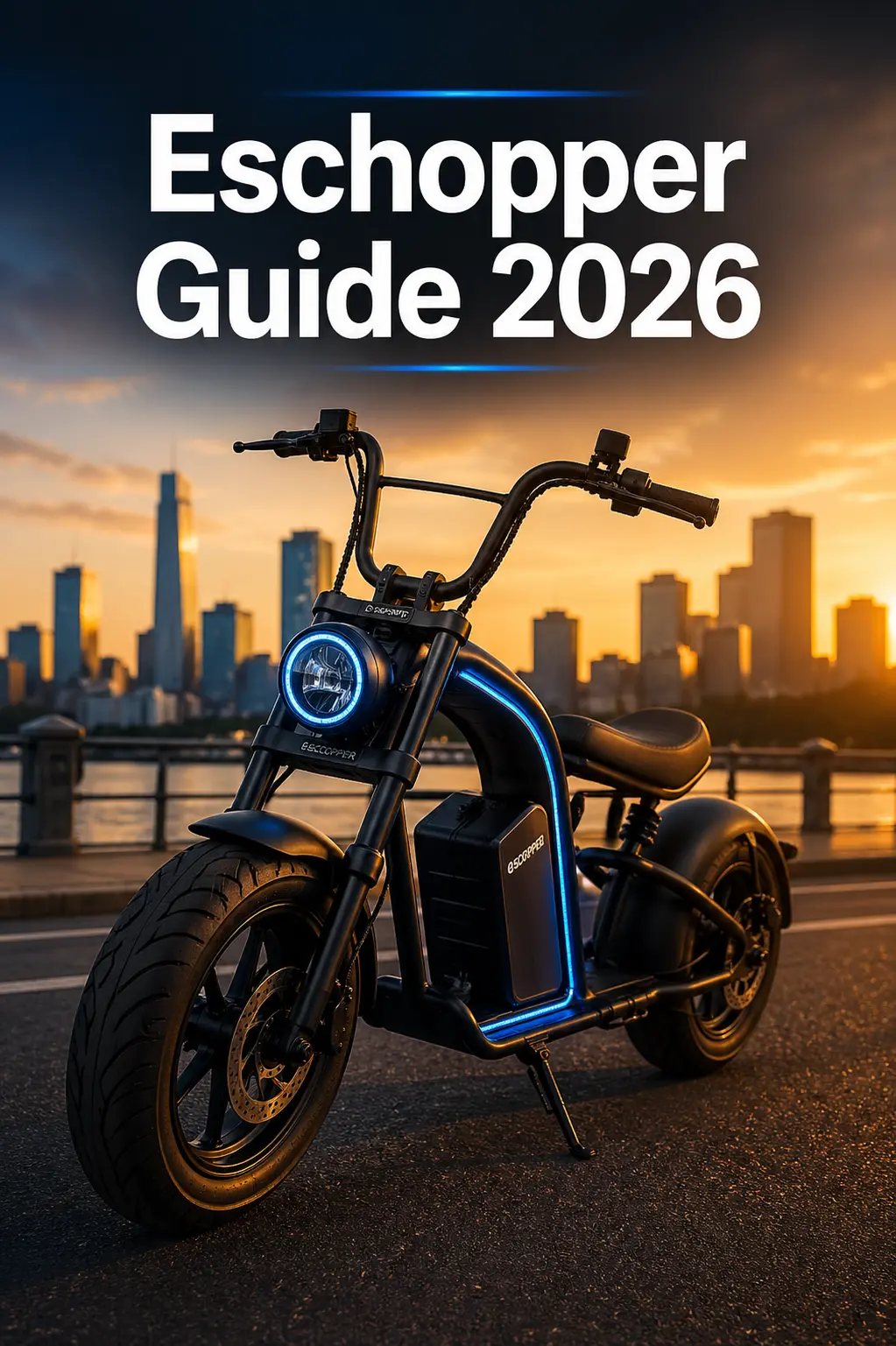
You’re stuck in traffic again — same 45-minute crawl, same $60 tank, same frustration. Then someone on a low-slung, chopper-style electric ride cruises past you in the bike lane without a care in the world. That machine has a name: the eschopper, and it’s quietly becoming one of the smarter transport decisions Americans are making in 2026.
This guide isn’t going to sell you on the idea. It’s going to show you exactly what an eschopper is, how it actually works in daily life, what it costs to own, and what most buyers get wrong the first time — so you don’t have to learn the hard way.
What Is an Eschopper, Really?
Most articles will tell you it’s just “an electric scooter with a chopper look.” That’s technically true but misses the point entirely.
An eschopper is a low-seat, wide-handlebar electric vehicle that borrows its soul from classic chopper motorcycles and swaps the roaring combustion engine for a quiet, torque-rich electric motor. The result is something that sits comfortably between a kick scooter and a full-sized electric motorcycle — more stable and powerful than the former, far more accessible and affordable than the latter.
The frame is stretched. The riding position is relaxed — legs forward, back upright, wrists loose. If you’ve ever sat on a cruiser motorcycle and thought “this is exactly how riding should feel,” that’s the eschopper experience, minus the noise, the gas, and the maintenance headaches.
Inside, most models run on a lithium-ion battery pack paired with a brushless hub motor seated in the rear wheel. Because there’s no chain, no belt, and no gearbox, the mechanical complexity drops dramatically. Fewer parts means fewer repairs. That simplicity isn’t a compromise — it’s the whole point.
Who Actually Rides an Eschopper?
Here’s something the competitor articles skip: not every rider needs the same thing, and the eschopper isn’t for everyone.
It makes the most sense for someone commuting 5 to 25 miles daily in a city or suburb. If your route involves bike lanes, relatively flat streets, and destinations where parking is a nightmare, an eschopper turns that problem into a non-issue. You park it where a bicycle parks. You charge it overnight like a phone. You spend roughly $0.03 to $0.08 per mile instead of whatever your car is costing you right now.
Remote workers who make short daily trips — coffee shop, coworking space, grocery run — have been particularly drawn to eschoppers over the past two years. The vehicle matches the rhythm of their lives without demanding full car ownership logistics.
It’s also genuinely fun for weekend riders who want something with style and personality. The classic chopper aesthetic turns heads, and that matters to a lot of people in a way they don’t always admit out loud.
Where it doesn’t make sense: long highway distances, hilly rural terrain without charging access, or situations where you legally need a vehicle with registration and insurance from day one. More on that below.
How the Electric Drivetrain Works in Plain English
You twist the throttle. The controller reads that input and sends power from the battery to the hub motor. The motor spins the rear wheel. You move forward. That’s genuinely the entire sequence.
No warming up the engine. No shifting gears. No clutch. The power delivery is smooth and immediate because electric motors produce maximum torque from a dead stop — which is also why eschoppers feel so responsive in city traffic compared to gas-powered alternatives.
Regenerative braking is a feature worth understanding on models that offer it. When you release the throttle or apply the brake, the motor switches roles and acts as a generator, converting kinetic energy back into stored battery power. It’s not a massive range boost — maybe 5 to 10 percent in urban stop-and-go conditions — but it’s a real benefit that reduces brake wear and slightly extends your riding range over time.
Battery capacity is measured in watt-hours (Wh). A 1,000 Wh battery on a typical eschopper will get you somewhere between 25 and 45 miles of real-world range depending on rider weight, terrain, and speed. Manufacturers quote higher numbers in ideal conditions. Trust the lower end of the advertised range for your daily planning.
The Real Cost of Owning an Eschopper
Entry-level models in the US market start around $800. Mid-range options with better motors and longer-lasting battery cells typically run $1,500 to $2,500. Premium builds with IP65 waterproofing, dual suspension, and brand-name battery cells can reach $3,500 to $4,000.
That upfront cost is the one number most buyers fixate on, and it’s often the least useful lens for evaluating the purchase.
The more honest calculation looks like this: a mid-range eschopper at $2,000 will cost you roughly $80 to $120 per year in electricity to charge, assuming daily use. Maintenance — tire checks, brake adjustments, occasional cable inspection — runs maybe $50 to $100 annually on a quality build. There’s no oil change, no spark plug, no exhaust repair. If your current commute costs you $150 a month in gas alone, the eschopper pays for itself in 14 to 18 months.
The hidden cost that catches people off guard is battery replacement. Lithium-ion packs degrade over charge cycles. A quality battery from a reputable manufacturer — think LG or Samsung cells — should last 500 to 800 full cycles before capacity drops noticeably. That translates to roughly 3 to 5 years of daily use before you’re considering a replacement, which typically costs $200 to $500 depending on the model.
Buy cheap, replace expensive. It’s the universal rule of electric vehicle batteries, and it applies just as much to a $900 eschopper as it does to a Tesla.
Legal Realities Across the US — What You Must Know
This is the section most eschopper articles gloss over, and it’s the one that can actually cost you money or get your ride impounded.
There is no single federal standard for how eschoppers are classified in the US. Regulations are set at the state level, and sometimes at the city level, creating a genuinely confusing patchwork of rules.
In many states, an eschopper with a motor under 750 watts and a top speed below 20 mph is treated as an electric bicycle, meaning no license, no registration, and no insurance required. Bump that power or speed above those thresholds and you enter moped or motorcycle territory, which triggers licensing and registration requirements in most states.
California, New York, and Florida all have distinct rules. Some cities ban higher-powered electric two-wheelers from protected bike lanes entirely. Before you buy, go directly to your state’s DMV website and search for “electric scooter” or “micromobility” classifications. Don’t rely on the seller to get this right — they often don’t.
The practical advice: if you want the simplest legal path, choose a model that stays under 750W and 20 mph on paper. You’ll still have plenty of power for city riding, and you’ll avoid a bureaucratic headache.
Choosing the Right Model — What Actually Matters
Most spec sheets shout about top speed. Ignore that number almost entirely. The features that determine whether your eschopper serves you well for years are less glamorous but far more important.
Battery cell quality is the single most consequential variable in long-term satisfaction. A battery built with name-brand cells and a quality Battery Management System will outlast a generic pack by two to three years under identical use. Ask the seller specifically which cells the battery uses. If they don’t know, that’s an answer in itself.
Motor wattage matters for hills and load. A 500W motor handles flat city streets comfortably. If your commute involves consistent inclines, look for 750W to 1,000W. Torque at low speed is what you’ll actually feel — not peak wattage figures.
Waterproofing gets ignored until it rains. An IP54 rating handles light splashes. IP65 handles genuine rain riding. If you live somewhere like Seattle or Miami, treat waterproofing as a non-negotiable.
Suspension — even a basic front fork — makes a meaningful difference on American urban roads, which are rarely as smooth as manufacturer test videos suggest. Dual suspension is worth paying for if your budget allows.
Finally, test-ride before you buy whenever possible. The ergonomics of an eschopper are personal. Seat height, handlebar reach, and throttle feel vary between models in ways that specs never capture.
Final Thoughts
The eschopper isn’t a trend. It’s a practical answer to a real problem — the cost, stress, and environmental impact of urban transportation — wrapped in a design that actually has some personality.
If you go in with clear expectations about range, understand your local regulations, and prioritize battery quality over flashy specs, an Eschopper Guide decision made today can genuinely pay you back for years. The riders who regret their purchase almost always cut corners on one of those three things. The ones who love it prepared before they bought.
Your next step is simple: measure your actual daily commute distance, check your state’s classification rules, and look at models in the $1,500 to $2,500 range with documented battery cell quality. Start there and you’ll be ahead of 90 percent of first-time buyers.
FAQS
What exactly is an eschopper and how is it different from a regular electric scooter?
An eschopper combines classic chopper motorcycle styling — low seat, wide handlebars, stretched frame — with an electric drivetrain. Regular e-scooters prioritize compactness and utility. The eschopper prioritizes riding comfort, stability, and aesthetic personality alongside practical commuting.
How far can an eschopper travel on a single charge?
Real-world range typically falls between 25 and 45 miles per charge depending on battery size, rider weight, and terrain. Manufacturer claims are usually measured under ideal conditions, so always plan around the lower estimate.
Do I need a license to ride an eschopper in the US?
It depends on your state and the scooter’s power output. Models under 750W and 20 mph are often classified as electric bicycles and require no license. Higher-powered models may be classified as mopeds or motorcycles, requiring registration and a valid license.
How long does an eschopper battery last before needing replacement?
A quality lithium-ion battery with reputable cells typically lasts 500 to 800 charge cycles — roughly 3 to 5 years of daily use — before capacity drops significantly. Cheaper battery packs can degrade in under two years.
Is the eschopper worth buying in 2026?
For urban commuters traveling 5 to 25 miles daily, yes. The combination of low operating costs, zero emissions, easy parking, and genuine riding enjoyment makes the eschopper a genuinely smart choice when you select the right model for your actual needs.