 By Benjamin Lewis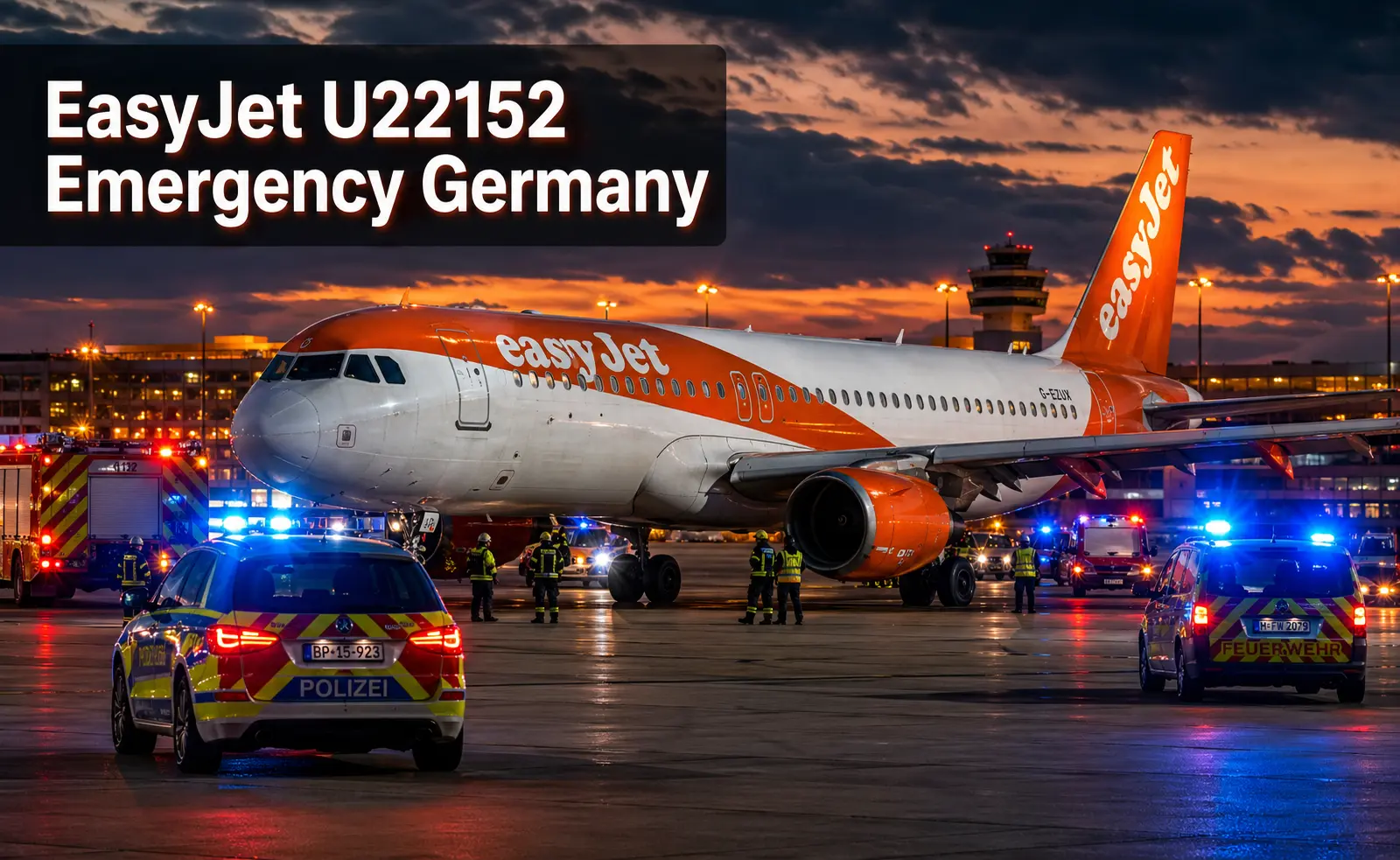
Picture this: you’re settled into your seat somewhere over Germany, expecting to land in Manchester in a couple of hours, when the flight suddenly changes course. The engine hum shifts. The cabin crew moves quickly but quietly. Then the captain’s voice comes over the intercom. That’s exactly what 185 passengers experienced on EasyJet U22152 emergency Germany — and what unfolded next is one of the clearest demonstrations of how modern aviation handles a genuine crisis in the air.
This wasn’t a vague “technical alert.” This was a first officer collapsing in the cockpit at cruise altitude, leaving a single captain to bring an Airbus A320 and nearly 200 souls safely down to earth in a foreign country. Here’s everything that actually happened, why it matters to anyone who flies with budget airlines from the UK, and what it tells us about air travel safety in 2025.
The Flight That Changed Course Over Germany
EasyJet flight U22152 was operating a scheduled passenger service from Istanbul to Manchester — a route that covers roughly 1,650 miles and typically takes around four hours. The aircraft was an Airbus A320-200 registered G-EZRX, and on board were 185 passengers and crew members, all expecting a perfectly routine evening journey across Europe.
On 15 August 2025, U22152 departed Istanbul and climbed to its cruise altitude of around 36,000 feet. For much of the journey everything appeared standard — smooth flight, cooperative weather, and a planned arrival in the UK later that day. Then, approximately two and a half hours into the flight, everything changed.
What Happened to the First Officer
While cruising at flight level 360, the first officer began experiencing severe abdominal pain. This was not mild discomfort or ordinary air sickness. The pain was intense enough to render the first officer effectively incapacitated and unable to perform their duties as the pilot monitoring the aircraft.
The flight was less than two hours from Manchester when the collapse occurred over German airspace. The captain declared an emergency, turned toward Cologne, and began descending with 185 people on board. At 15:41 UTC, the aircraft began broadcasting squawk 7700 — the internationally recognised emergency transponder code that signals to every air traffic controller in range that this aircraft needs priority handling immediately.
Within minutes, German air traffic control had cleared the path. Cologne Bonn Airport was alerted. Ground emergency teams were standing by. What makes this incident remarkable isn’t that something went wrong — it’s that every single system designed to handle this exact scenario activated precisely as intended.
Why the Captain Diverted to Cologne, Not Manchester
Some people reading about the EasyJet U22152 emergency Germany incident have asked a reasonable question: why not press on to Manchester? The flight was less than two hours away. Wouldn’t continuing have been simpler?
The answer is no, and understanding why reveals something important about how pilots are trained to think under pressure.
Diverting to Cologne allowed medical professionals to reach the sick first officer as quickly as possible and minimised the time the aircraft had to operate with only one active pilot. That’s the core logic — act early, reduce risk, and treat any health crisis in the cockpit as urgent rather than manageable. With one pilot incapacitated and 185 people on board, the captain needed the closest suitable airport, not the largest or most familiar one.
Cologne Bonn Airport sits roughly 150 nautical miles from where the emergency was declared — close enough to reach quickly, large enough to handle an A320, and fully equipped with emergency medical services. Germany’s air traffic management system is among the most advanced in Europe, and its controllers are trained to handle priority diversions efficiently. From the moment squawk 7700 went out, Cologne’s ground teams were already preparing for arrival.
What the Captain Did Alone in the Cockpit
This is the part of the story that rarely gets the attention it deserves.
Flying a commercial aircraft alone — even briefly, even with all systems functioning normally — is not a standard condition. The A320 is a fly-by-wire aircraft with significant automation, but automation doesn’t replace the second pilot’s role in monitoring systems, running checklists, and communicating with air traffic control. The captain flew the entire diversion alone in a foreign country: managing German ATC communications, completing approach procedures, coordinating with cabin crew, and putting the aircraft down cleanly at an unfamiliar airport.
There is a well-established protocol in commercial aviation specifically designed for this scenario. Pilots on the same flight are typically advised to eat different meals — if one meal is contaminated, the other pilot remains healthy and able to fly. Whether that rule was followed on U22152 is not publicly confirmed, but the fact that only the first officer fell ill while the captain remained fully fit and functional strongly suggests the separation may have done exactly what it was designed to do.
What the captain accomplished that afternoon over Germany was the product of rigorous, repeated training — simulator sessions run twice a year, emergency procedure drills, and single-pilot incapacitation scenarios practiced until the response becomes instinct.
The Suspected Cause: Food Poisoning at 36,000 Feet
Food poisoning was the suspected cause of the first officer’s incapacitation, though no hospital confirmation was ever made public and EasyJet’s official statement did not name a specific cause. That might seem like an unsatisfying answer, but it reflects how aviation incident reporting actually works.
Unless there is an accident — meaning structural damage to the aircraft or physical injury to passengers — formal investigation reports aren’t always published. As of early 2026, no formal report had been released by aviation authorities in either the UK or Germany for the U22152 incident. For a crew incapacitation event that did not result in an accident, that is not unusual procedure.
What is worth knowing is that pilot incapacitation from foodborne illness is a documented and tracked risk in commercial aviation. Historical safety data shows that stomach illness and nausea represent the single largest category of pilot incapacitation across recorded incidents — which is precisely why the two-pilot meal separation rule exists and why single-pilot incapacitation procedures are drilled into every commercial captain before they ever set foot on a live flight deck.
The EasyJet U22152 emergency Germany event wasn’t a freak occurrence. It was a known risk category meeting a well-prepared response.
How the Passengers Experienced the Diversion
From a passenger’s perspective, the diversion would have felt sudden but controlled. Cabin crew are trained to pause normal service, secure the cabin, and prepare passengers for an earlier-than-expected landing without triggering panic. Travellers on board would have noticed a change in engine tone as the aircraft began descending and turning away from its original route — and they would have heard an announcement that a medical situation required an early landing.
Emergency vehicles lined the runway at Cologne on arrival — a sight that unsettles many passengers — but their presence was procedural, not a signal that anything catastrophic was occurring. Their job was to be ready, not because disaster was expected but because readiness is the standard.
Those 185 passengers did not reach Manchester until the early hours of the following morning, nearly eight hours after their scheduled arrival. That’s a significant and genuinely difficult disruption — especially for families with children, passengers with connecting trains or onward flights, or anyone who simply wasn’t prepared to spend most of a Friday night in a German airport.
Whether EasyJet provided adequate care during that seven-hour Cologne ground stop — meals, water, access to communication — was never confirmed in any public statement from the airline. That silence is a gap passengers deserved better on.
Your Rights as a UK Passenger After a Medical Diversion
This is something most coverage of the EasyJet U22152 emergency Germany incident skipped entirely, and it matters if you were on this flight or face something similar in future.
Under UK261 regulations — the post-Brexit passenger rights framework that still protects British travellers on flights departing the UK or operated by UK-based airlines — crew medical emergencies are classified as extraordinary circumstances. That means airlines are not required to pay the standard fixed-rate delay compensation when a diversion is caused by a sudden medical event outside their operational control.
Claims circulating online after the U22152 incident suggested EasyJet automatically paid compensation to all passengers. That was not supported by any verified source or by how UK261 law actually applies to medical emergency diversions.
What EasyJet was legally required to do regardless of compensation liability is provide duty of care during the delay — meals, refreshments, and access to communication at minimum. If you were on this flight and those basic provisions weren’t delivered during the ground stop, that is worth pursuing with the UK Civil Aviation Authority separately from any delay compensation claim.
EasyJet’s Safety Record in Context
It would be easy to read about the EasyJet U22152 emergency Germany incident and feel uneasy about flying with a budget carrier. That reaction is understandable. But the data tells a different story.
EasyJet holds a strong independent safety rating and was ranked among the safest low-cost airlines in the world as recently as 2024. Its fatality-free passenger record remained intact after Cologne. From mid-2024 through late 2025, EasyJet dealt with several medical emergency diversions on UK routes — and not one resulted in passenger injuries. In each case, the remaining pilot declared an emergency, followed procedure, and landed safely.
That pattern is the actual point. The measure of an airline’s safety culture isn’t whether unexpected events occur — they always will, on every airline, on every route. The measure is how the airline and its crews respond when they do. On U22152, the captain made the correct call within the correct timeframe. The aircraft landed safely. The first officer received hospital treatment. A replacement crew was arranged, and all 185 passengers eventually made it home.
Final Thoughts
The EasyJet U22152 emergency Germany incident is a story about what happens when a system built for exactly this moment actually works. A first officer became seriously ill over German airspace at 36,000 feet. The captain responded immediately, declared squawk 7700, diverted to Cologne Bonn Airport, and put 185 people down safely without a single injury. That outcome wasn’t fortune — it was the result of training, established procedure, and an aviation framework designed to convert single-point failures into controlled, survivable situations.
For UK travellers, the real takeaway isn’t that EasyJet had a frightening incident over Germany. It’s that the entire European aviation system — the two-pilot rule, the meal separation protocol, the squawk 7700 network, the German air traffic control infrastructure, the Cologne ground emergency teams — all functioned together in under an hour to keep everyone safe. That should give you more confidence in air travel, not less. The next time you board a flight and the cabin crew run through safety briefings, know that behind those words sits a system that has been tested at 36,000 feet — and passed.
FAQS
What was the EasyJet U22152 emergency Germany incident?
EasyJet flight U22152 was flying from Istanbul to Manchester on 15 August 2025 when the first officer collapsed with severe stomach pain over German airspace. The captain declared an emergency, diverted to Cologne Bonn Airport, and landed safely with all 185 passengers on board. No injuries were recorded.
What caused the first officer to collapse on flight U22152?
Food poisoning was the suspected cause, though no official hospital confirmation or formal investigation report was ever published. Aviation authorities do not always open full investigations for crew incapacitation events that do not result in an accident or passenger injury.
Were passengers in danger during the EasyJet U22152 emergency Germany diversion?
No. The captain remained fully fit and flew the diversion alone following standard single-pilot incapacitation procedures. The aircraft landed at Cologne without complications, and no passengers were harmed at any point during the incident.
Are passengers entitled to compensation for the U22152 delay?
Under UK261 regulations, crew medical emergencies are classified as extraordinary circumstances, so the standard fixed-rate delay compensation does not apply. Passengers were entitled to duty of care during the delay — food, water, and communication access — though whether that was provided at Cologne was never publicly confirmed by EasyJet.
Is EasyJet still considered a safe airline after the EasyJet U22152 emergency Germany incident?
Yes. EasyJet holds strong independent safety ratings and was ranked among the world’s safest low-cost carriers in 2024. The U22152 incident, while serious, demonstrates how effectively the airline’s safety protocols function under genuine pressure — rather than indicating any broader safety problem with the carrier.